
How St Helens let Super League success become long-term stagnation - the flap of a wing!
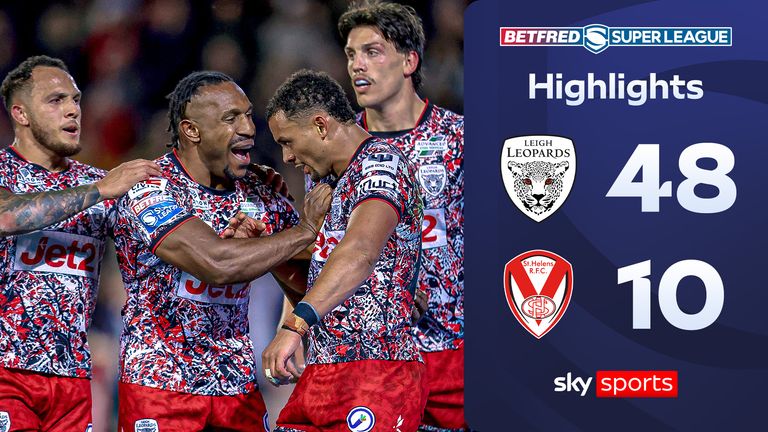
The dust has settled on the fact that St Helens have missed out on play-off rugby for the first time after their seventh-placed finish in Super League.
The analytical dissection of how this happened has been ongoing by fans and pundits for the best part of two years. Some supporters would say longer.
The next 12 months will give an indication of how long those with power inside the four walls of the club have realised that their trajectory has been downwards.
The famous question posed by meteorologist Edward Lorenz back in the 1970s was 'can the flap of a butterfly's wing in Brazil set off a tornado in Texas?'
Can the smallest of changes lead to significant outcomes in the most complex of systems?
If this low ebb for Saints is their tornado, what exactly was the flap of the wing? What exactly caused the chaos?
For that, we need to rewind to 2019, when they picked up their first Super League title in five years.
Midway through 2017, St Helens were sitting mid-table and made the decision to part ways with head coach Keiron Cunningham and bring in Justin Holbrook.
After a Luke Gale drop goal saw Saints heartbreakingly fall in the semi-finals in 2017 and somehow miss out in 2018 despite the genius of Ben Barba, 2019 marked the year when they were simply the best team around.
The Saints obliterated the competition in 2019, losing just three matches and cantering to the top of the league.
Their 23-6 win over Salford Red Devils in the Grand Final was the moment that cemented that St Helens were here once again.
It was a star-studded team with the likes of Jonny Lomax, Tommy Makinson, Alex Walmsley and Lachlan Coote all in their mid-to-late 20s and in their prime. A mix of homegrown talent and hand-picked Australian superstars was running the show.
They had to then overcome a change of head coach but, under Kristian Woolf, success would continue...
Woolf has spoken openly about the fact that the season shutting down due to Covid potentially saved his job.
Woolf's team had just lost to Huddersfield Giants and Castleford Tigers when the season went on hiatus.
By the time it returned, he had spoken with his playing group about what more they wanted from him and how they wanted things to run. A collaboration between a stern coach and a group striving for success - and continuing to achieve it - was born.
Jack Welsby scored one of the best Grand Final tries ever seen in 2020 and then two more Super League wins followed. Not only that, they won a Challenge Cup and a League Leaders' Shield.
Then they do the unthinkable...
When St Helens headed down under for the World Club Challenge in 2023, no one believed they could beat Penrith Panthers.
Hometown head coach Paul Wellens moved from captain and player to assistant coach, and after over 10 years in the coaching game at the club, he had stepped up to the top job.
Then, Lewis Dodd sent over a golden-point drop goal that is lauded as one of the most seismic moments in the sport in this country.
They had climbed to the top of Everest and planted the St Helens flag.
You have won it all, your players have provided every success you have asked for.
So what is the next task? Is it starting a transition period? Is it trusting this same group of players to provide once again? Is it a mix of both?
St Helens went for option B...
Big players were winning big and getting their reward, deservedly so. But in a salary-capped sport, there comes a time where that may start to bite.
By this point, the likes of Makinson, Lomax, Walmsley, Mark Percival, Louis McCarthy-Scarsbrook and Sione Mata'utia had brought unprecedented success. They were also now mostly in their 30s.
Naturally, with that, comes upgraded contracts. Simply put - you win more you deserve to earn more.
But, if contracts are being upgraded year on year, the space on a salary cap dwindles. Your chance to bring in big names dwindles. Your room for youngsters to be earning well dwindles.
A sum of £2.1m only stretches so far and you need to be ruthlessly pragmatic. Or players need to be willing to earn less than what they were receiving in their 20s. A tough sell!
Over the next three seasons under Wellens, St Helens would make just 11 signings to replace the likes of Regan Grace, James Roby, Will Hopoate, Makinson, Lewis Dodd and Mata'utia.
Those signings were Tee Ritson, Wesley Bruines, Daryl Clark, Waqa Blake, Kyle Feldt, Tristan Sailor, Lewis Murphy, Moses Mbye, Matt Whitley, Shane Wright and Deon Cross.
Wright and Cross only became available due to the financial collapse of Salford Red Devils.
Some would argue those big boots have still not been filled. Or if they have been filled, the successor has not matched up to their predecessor.
Back in 2025, former St Helens CEO Mike Rush described the club's recruitment strategy as 'Moneyball'.
Moneyball is a term coined from Michael Lewis' book which analysed how, in 2002, Oakland Athletics and their general manager Billy Beane used a statistical approach that saw them sign players whose skills might be being undervalued on traditional methods of scouting.
You sign players to fulfil particular roles, for example making lots of tackles or making metres, knowing they lack in other areas, so that you can still compete despite being hampered by a budget.
Recomended Posts




Latest News
© 2026 - VIPBOX - All Rights Reserved

Leave a Comment